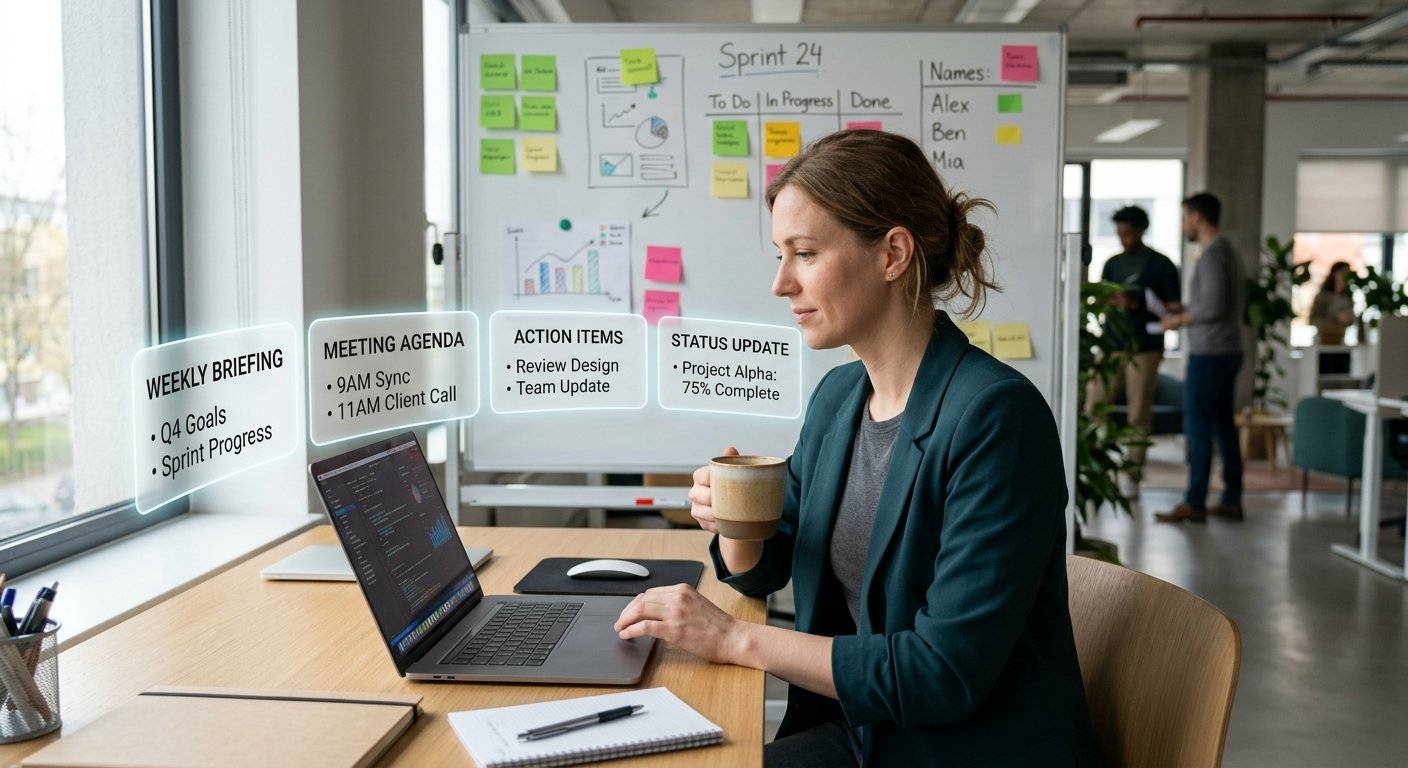
Problem
Coordination work drains the people who should be deciding
Professionals spend enormous time on coordination work: status updates, meeting prep, follow-up summaries, task routing, and information synthesis.
This work is necessary, predictable, and low-judgment - exactly the profile where humans are least valuable and most drained. Delegating it to AI as a one-off task captures some value. Delegating it as a structured, repeatable workflow captures far more.
Value
Attention shifts from managing information to using it
Context
When this pattern applies
Multi-step workflows, project coordination, or any recurring process that involves organizing information, tracking status, routing tasks, or synthesizing inputs from multiple sources.
Applies when the work is structured but time-consuming - the kind of coordination work that rarely requires judgment but always requires attention.
Check first whether the coordination is the problem or a symptom. Status chasing often exists because the process is broken or handoffs don't work. Automating it can lock a bad process in place. Fix the stream first, then automate what's left (see Redesign the Stream, Not the Role, coming soon).
Solution
Assign AI a standing coordination role
Define a recurring coordination role and assign it to AI as a persistent function. Structure the AI's role with a standing context document (see Onboard, Don't Program) that describes the project, stakeholders, decision history, and current state. Treat each session as a handoff, not a cold start.
Chat sessions don't remember on their own, so give the standing context a home: a document the AI reads at the start of every session, or a project's knowledge files. Update it as decisions are made, so the next session starts from the current state.
Weekly
Synthesize project status from notes, emails, or tool exports; produce a briefing
Meeting Prep
Pull context from prior sessions; draft agenda and talking points
Post-Meeting
Capture decisions and action items in a structured format
Async Updates
Route information to the right summary document or channel
Cross-Project Risk
Flag risks and dependencies across projects, not just summarize each one's status
Notes
The entry point for most agentic deployments
This pattern is the entry point for most agentic AI deployments in professional services.
The pattern extends naturally into tool-connected agents (calendar, email, project management) when those integrations are available.
Decide where the freed time goes. This changes the coordinator's job; it shouldn't quietly erase it. Name the higher-value work the time moves to before you start (see Pattern 11, The Productivity-to-Headcount Trap).
At scale. Inside Anthropic, the share of employees’ AI sessions spent managing agents - writing instructions, building dashboards, monitoring pipelines - rose from 10% to 22% in about six months, and one engineer set up an “agent chief of staff” to triage agent requests (Wilmers, Catipon, Massenkoff and McCrory, “How Employment is Changing at Anthropic,” Anthropic, October 16, 2026). That is this pattern, run for real.
Give the role a handoff record. A standing AI coordinator is exactly the kind of asset that becomes a ghost when its owner leaves (see Pattern 12, Ghost in the Workflow).